
deepseek-v4
DeepSeek-V4 Agent Coding: Capabilities and Use Cases
DeepSeek-V4 Team · June 18, 2026 · 5 min read
Keywords: deepseek-v4 agent coding, deepseek v4 web chat, deepseek agent workflow
Published: June 18, 2026 Author: DeepSeek-V4 Team
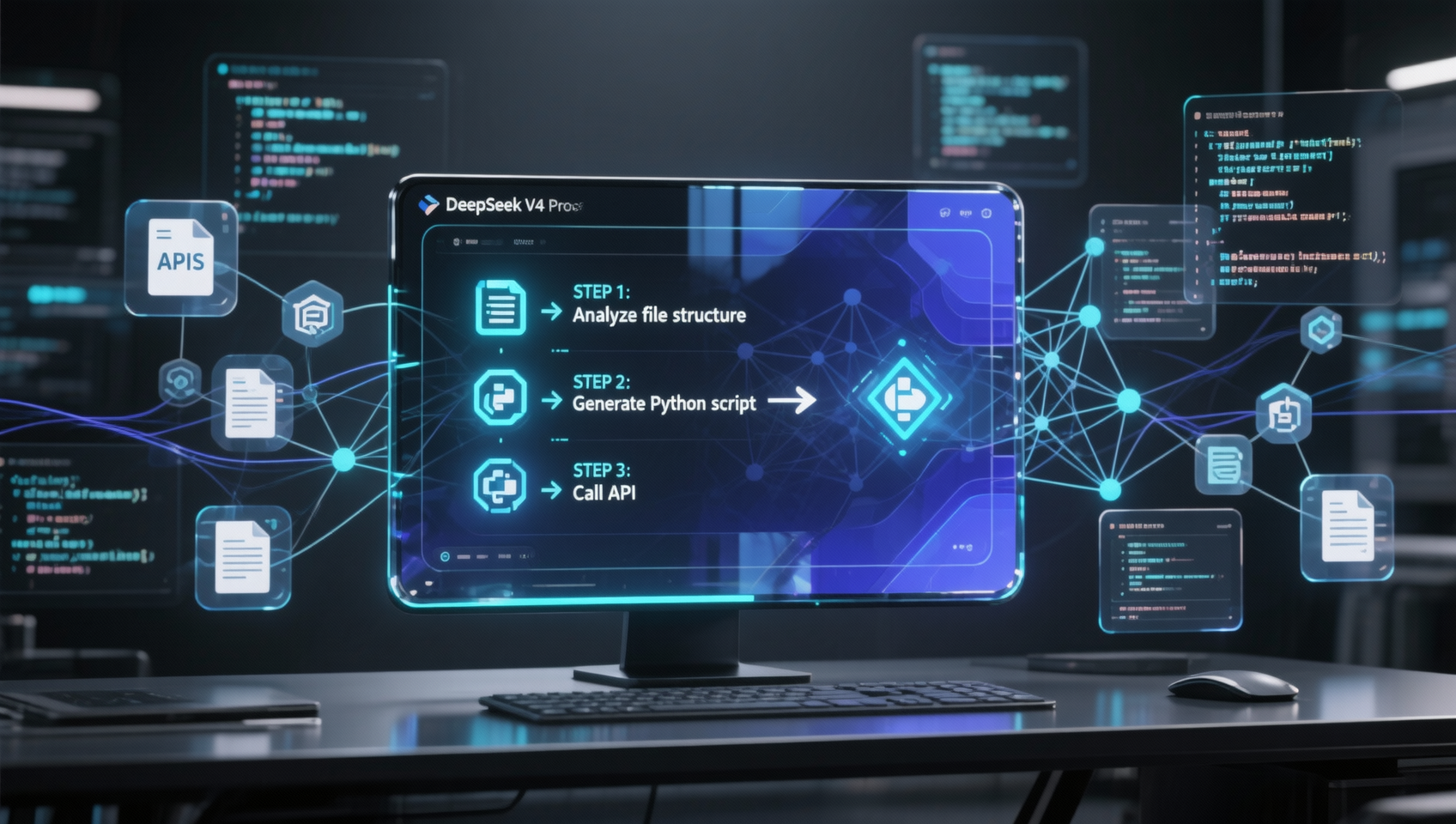
What “Agent Coding” Means in DeepSeek-V4 — No Setup Required
“Agent coding” with DeepSeek-V4 isn’t about installing tools or configuring local environments. It’s about orchestrating code generation, execution, and iteration directly in your browser — using DeepSeek-V4 Pro’s built-in agent capabilities via the MidassAI Chat web interface. No CLI, no Docker, no pip install. Just paste a repo link, upload a .py file, or describe a task like “Refactor this Flask route to use SQLAlchemy async sessions and add Pydantic validation”, and DeepSeek-V4 Pro acts as both strategist and executor.
This works because DeepSeek-V4 Pro (not Flash) runs full agent workflows natively in the web chat: it reasons step-by-step, calls internal tool APIs (e.g., code interpreter, file reader, HTTP client), validates outputs, and loops — all within a single session. The 1M context window ensures it retains full project structure across long interactions — critical when you’re debugging a 3-file FastAPI service or auditing a 500-line data pipeline.
You don’t need to know Python’s subprocess module or write custom tool wrappers. DeepSeek-V4 Pro handles tool invocation, sandboxed execution, and error recovery — and surfaces results cleanly in Markdown with syntax-highlighted diffs, stack traces, or curl-ready API snippets.
Real-World Agent Coding Workflows You Can Run Right Now
Here’s what’s possible today — no setup, no config:
Multi-file refactoring: Upload
models.py,schemas.py, androutes.py, then ask “Update all models to use SQLAlchemy 2.0 declarative base and migrate schemas to Pydantic v2 with field validation”. V4-Pro parses dependencies, generates consistent changes, and previews each file diff before applying.CLI tool scaffolding: Say “Build a CLI that accepts
--input(CSV path),--output(JSONL), and--transform(lambda string), then converts rows using pandas and writes streaming output”. V4-Pro writes the Click-based script, tests it with synthetic data, and returns a ready-to-run.pyfile — plus usage examples.API integration debugging: Paste a failing
curlcommand + error log → “Diagnose why this Stripe webhook fails 400 on signature verification, then generate a minimal Python test harness that reproduces and fixes it.” V4-Pro inspects headers, decodes payloads, simulates signature logic, and outputs verified test code.Legacy code modernization: Drop a 2015-era Django
views.py→ “Convert class-based views to function-based views with type hints, replacerender_to_responsewithrender, and add basic DRF serializer equivalents.” V4-Pro preserves business logic while upgrading patterns — and explains each change.
All of these execute in-browser, using MidassAI Chat’s secure, ephemeral runtime. Your files never leave the client; code runs in a lightweight WebAssembly sandbox. No tokens sent to third-party services. No API keys exposed.
Quick Takeaways
Why DeepSeek-V4 Pro — Not Flash — Powers Real Agent Coding
DeepSeek-V4-Flash excels at fast, stateless Q&A: “What’s the regex for matching ISO 8601 dates?” or “Explain TCP three-way handshake.” But agent coding demands stateful, multi-turn orchestration: planning → tool selection → execution → validation → revision.
| Feature | DeepSeek-V4 Pro | DeepSeek-V4 Flash |
|---|---|---|
| Agent loop support | ✅ Full built-in reasoning + tool calling (code interpreter, HTTP, file I/O) | ❌ Single-turn only — no internal state or tool chaining |
| Context retention | 1M tokens — holds full monorepo docs + 10+ uploaded files + full conversation history | ~128K tokens — suitable for short scripts or snippets only |
| Vision capability | ✅ Accepts diagrams, architecture sketches, or screenshots of UIs and reasons over them | ❌ Text-only input |
| File handling | ✅ Reads, compares, and modifies multiple uploaded files (.py, .js, .yaml, .md) in one session | ⚠️ Limited to single-file pastes or small text inputs |
If your goal is writing, debugging, or evolving real software, not just answering isolated questions, V4-Pro is the only version that delivers end-to-end agent coding in the browser.
Who This Is For — And Who Should Skip It
This workflow fits you if:
- You’re a developer who spends >30 mins/day writing boilerplate, debugging integrations, or translating specs into code — and wants to cut that time without managing LLM infrastructure.
- You work across repos or projects and need context-aware help (e.g., “Update this Next.js API route to match the new auth middleware pattern used in
/packages/auth”). - You’re evaluating AI coding assistants but distrust black-box outputs — V4-Pro shows its reasoning chain, tool calls, and intermediate results so you stay in control.
- You’re on a shared or locked-down machine (corporate laptop, Chromebook, iPad) where installing Python packages or Ollama isn’t allowed — or desirable.
It’s not for you if:
- You require offline operation (this is cloud-native web chat only).
- You need fine-grained model quantization control or custom LoRA adapters (that’s local-deploy territory — outside this article’s scope).
- Your priority is raw token speed for simple completions — use V4-Flash instead.
Getting Started: Your First Agent Coding Session in < 60 Seconds
- Go to https://www.midassai.com/chat/
- Select DeepSeek-V4 Pro from the model dropdown (top-right corner)
- Paste a coding task — e.g., “I have a pandas DataFrame with columns
user_id,timestamp,event_type. Generate code to compute 7-day rolling active user count byevent_type, then plot with seaborn.” - Click Upload Files (optional) if you have CSVs or existing scripts to contextualize
- Hit Enter → watch V4-Pro plan steps, run code in sandbox, validate output, and return clean, documented results
No sign-up. No credit card. No download. Your first agent-assisted refactor starts now.
The power isn’t in the model alone — it’s in how V4-Pro operates as a collaborator: reading your intent, testing assumptions, adapting to failures, and explaining tradeoffs. That’s not automation. It’s amplification.
Try it. Refactor something real. Then decide whether “AI coding assistant” still feels like a buzzword — or your new pair programmer.